

Thermoelectric Fiber & Yarn Systems for Wearable Power Market Valuation, ROI Potential & Long-Term Growth 2026–2036
Thermoelectric Fiber & Yarn Systems for Wearable Power Market
MD, UNITED STATES, February 5, 2026 /EINPresswire.com/ -- The global Thermoelectric Fiber and Yarn Systems for Wearable Power Market is poised for significant growth over the next decade, driven by rapid advancements in smart textiles, wearable electronics, and energy-harvesting technologies. As industries increasingly seek self-powered and battery-free wearable solutions, thermoelectric fibers and yarns are emerging as a transformative technology that converts body heat into usable electrical energy.
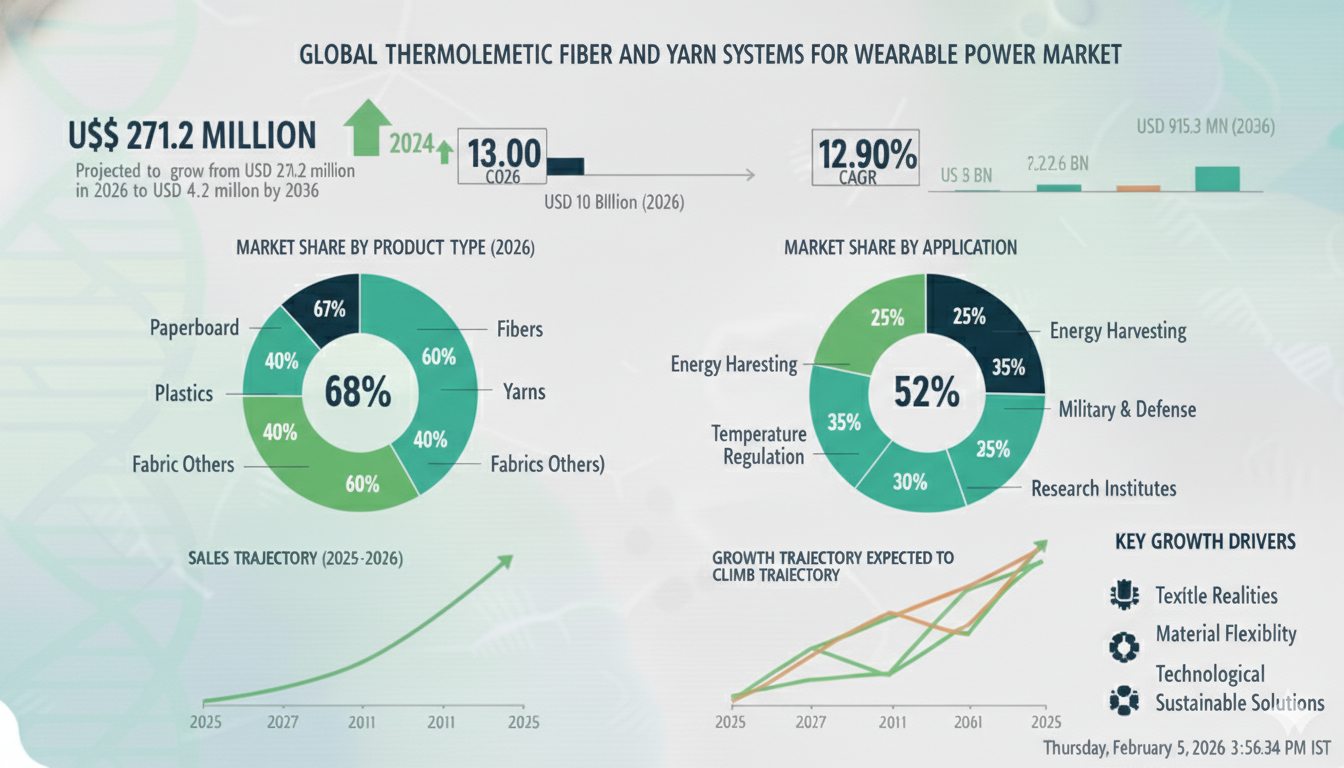
According to recent market research by Future Market Insights, the market is expected to expand steadily between 2026 and 2036, supported by strong demand from healthcare, defense, industrial safety, and consumer wearable applications. In 2026, the market is valued at approximately USD 0.24 billion and is projected to reach around USD 0.81 billion by 2036, registering a robust compound annual growth rate (CAGR) of about 13% over the forecast period.
Rising Demand for Self-Powered Wearables Fuels Market Expansion
The increasing adoption of wearable devices has created a growing need for reliable, continuous, and maintenance-free power sources. Traditional batteries add bulk, limit flexibility, and require frequent charging or replacement. Thermoelectric fiber and yarn systems address these challenges by harvesting energy directly from temperature differences between the human body and the surrounding environment.
This capability makes thermoelectric textiles particularly attractive for applications such as continuous health monitoring, fitness tracking, military uniforms, industrial safety garments, and smart clothing. As wearable technology evolves toward always-on, connected systems, energy-harvesting textiles are becoming a critical enabler of next-generation product design.
Healthcare and Defense Lead Adoption
Healthcare is one of the fastest-growing application segments for thermoelectric fiber and yarn systems. Wearable medical devices that monitor vital signs such as heart rate, temperature, and respiration require reliable power for continuous operation. Thermoelectric textiles help reduce dependence on conventional batteries, enabling lightweight, comfortable, and long-duration monitoring solutions for patients and elderly populations.
Similarly, defense and military organizations are increasingly investing in smart uniforms and wearable systems to enhance soldier performance, situational awareness, and safety. Thermoelectric fibers integrated into garments can support low-power sensors, communication devices, and tracking systems, helping reduce battery loads and improve operational efficiency in the field.
Technological Advancements Strengthen Commercial Viability
Ongoing innovations in materials science and textile engineering are significantly improving the performance, durability, and scalability of thermoelectric fibers and yarns. Manufacturers are focusing on developing flexible, washable, and mechanically robust thermoelectric materials that can be seamlessly integrated into conventional textile production processes.
Inorganic thermoelectric materials coated or embedded into fibers currently account for a significant share of the market, due to their higher energy conversion efficiency. At the same time, research into organic and hybrid thermoelectric materials is gaining momentum, offering improved flexibility and comfort for wearable applications.
Another key trend shaping the market is the development of hybrid energy-harvesting systems that combine thermoelectric technology with other mechanisms such as piezoelectric and triboelectric energy harvesting. These hybrid approaches enhance overall power output and ensure more consistent energy generation under varying environmental and usage conditions.
Smart Textile Ecosystem Drives Market Growth
The broader smart textile and e-textile ecosystem is playing a crucial role in accelerating market adoption. Collaborations between textile manufacturers, electronics companies, research institutions, and wearable technology developers are fostering innovation and accelerating commercialization.
As smart fabrics become more widely adopted across sports, fitness, fashion, and healthcare segments, thermoelectric fibers are increasingly being positioned as a core component of intelligent textile systems. The integration of sensors, connectivity, and energy-harvesting capabilities into a single fabric platform is enabling the development of multifunctional garments with enhanced value propositions.
Regional Outlook Highlights Asia and Europe
Regionally, Asia-Pacific is expected to remain a key growth engine for the thermoelectric fiber and yarn systems market. Countries such as China, Japan, and South Korea are leading innovation in smart textiles and advanced manufacturing, supported by strong investments in research and development.
Europe is also witnessing increasing adoption, particularly in medical wearables, defense applications, and sustainability-focused textile solutions. North America continues to play a major role in technology development and early-stage commercialization, driven by strong activity from wearable technology companies and research institutions.
Request For Sample Report | Customize Report |purchase Full Report -https://www.futuremarketinsights.com/reports/sample/rep-gb-31816
Future Outlook: Enabling the Next Generation of Wearable Power
Looking ahead, the thermoelectric fiber and yarn systems market is well positioned to benefit from long-term trends toward miniaturization, digital health, and connected living. As consumers and enterprises alike demand more autonomous, comfortable, and sustainable wearable devices, energy-harvesting textiles will become an increasingly important part of the wearable power ecosystem.
With continued advancements in materials, manufacturing processes, and system integration, thermoelectric fibers are expected to move beyond niche applications and gain broader commercial adoption. This evolution will open new opportunities for textile manufacturers, material suppliers, wearable device makers, and healthcare technology providers.
As the wearable technology landscape continues to evolve, thermoelectric fiber and yarn systems are set to play a pivotal role in shaping the future of self-powered smart textiles and next-generation wearable solutions.
Explore More Related Studies Published by FMI Research:
Phage MuA Transposase Market- https://www.futuremarketinsights.com/reports/phage-mua-transposase-market
Otoacoustic Emissions Hearing Screener Market- https://www.futuremarketinsights.com/reports/otoacoustic-emissions-hearing-screener-market
Mobile Animal Inhalation Anesthesia Machine Market- https://www.futuremarketinsights.com/reports/mobile-animal-inhalation-anesthesia-machine-market
Cardiac Monitoring And Cardiac Rhythm Management Devices Market- https://www.futuremarketinsights.com/reports/cardiac-monitoring-and-cardiac-rhythm-management-devices-market
About Future Market Insights (FMI)
Future Market Insights, Inc. (FMI) is an ESOMAR-certified, ISO 9001:2015 market research and consulting organization, trusted by Fortune 500 clients and global enterprises. With operations in the U.S., UK, India, and Dubai, FMI provides data-backed insights and strategic intelligence across 30+ industries and 1200 markets worldwide.
Why FMI: Decisions that Change Outcomes- https://www.futuremarketinsights.com/why-fmi
Contact Us:
Future Market Insights Inc.
Christiana Corporate, 200 Continental Drive,
Suite 401, Newark, Delaware – 19713, USA
T: +1-347-918-3531
Website: https://www.futuremarketinsights.com
LinkedIn| Twitter| Blogs | YouTube
Have a specific Requirements and Need Assistant on Report Pricing or Limited Budget please contact us - sales@futuremarketinsights.com
Sudip Saha
Future Market Insights Inc.
+1 347-918-3531
email us here
Legal Disclaimer:
EIN Presswire provides this news content "as is" without warranty of any kind. We do not accept any responsibility or liability for the accuracy, content, images, videos, licenses, completeness, legality, or reliability of the information contained in this article. If you have any complaints or copyright issues related to this article, kindly contact the author above.
