

Haptic Feedback Yarns Market Valuation, ROI Potential & Long-Term Growth Prospects 2026–2036
Haptic Feedback Yarns Market size
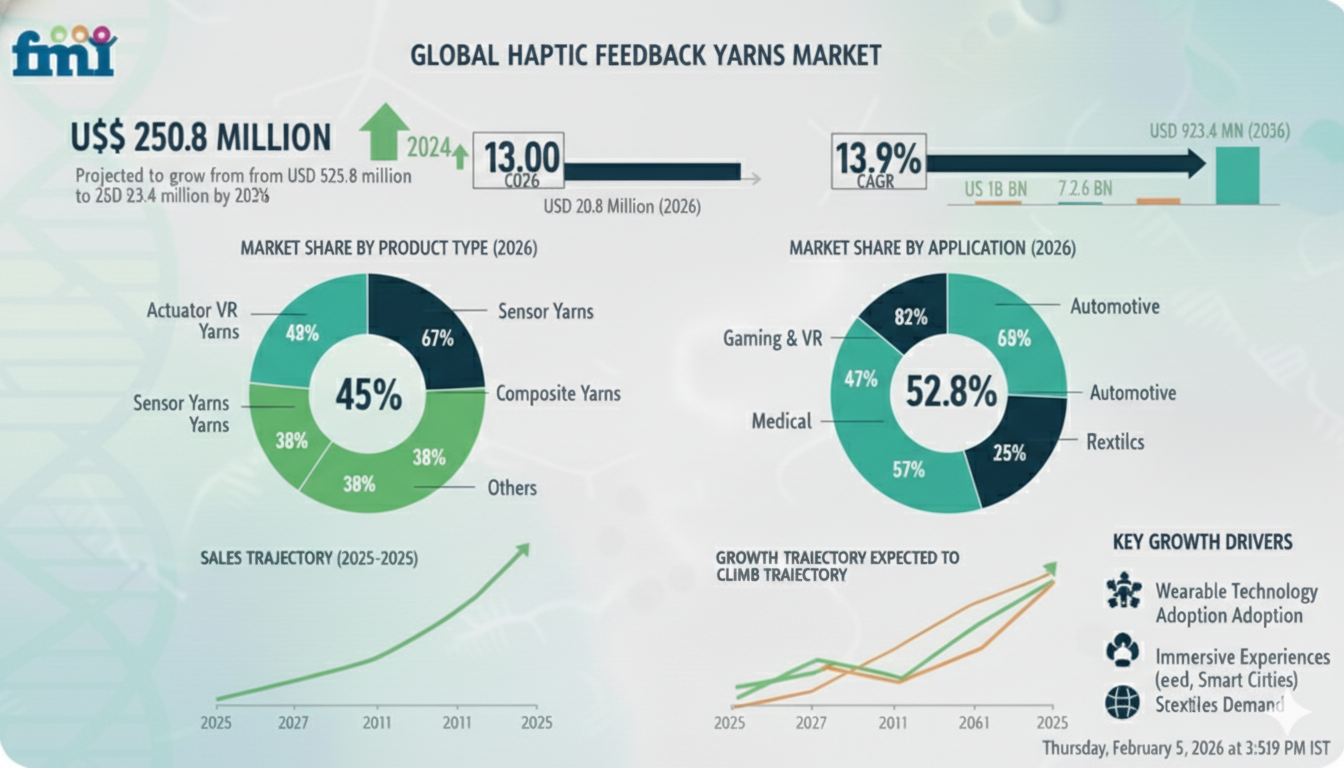
MD, UNITED STATES, February 5, 2026 /EINPresswire.com/ -- The global haptic feedback yarns market is poised for strong growth over the next decade, driven by accelerating adoption of smart textiles, wearable electronics, and immersive human-machine interaction technologies across multiple industries. According to industry estimates, the market is projected to grow from approximately USD 0.22 billion in 2026 to over USD 0.8 billion by 2036, registering a robust compound annual growth rate (CAGR) of around 14% during the forecast period.
Haptic feedback yarns are advanced textile materials engineered with conductive and electroactive components that enable tactile sensations such as vibration, pressure, and motion feedback within fabrics. These innovative yarns are transforming conventional textiles into interactive surfaces, enabling garments and fabrics to deliver real-time sensory feedback. This evolution is opening new opportunities across healthcare, consumer electronics, gaming, automotive interiors, defense, and industrial safety applications.
Smart Textiles and Wearables Driving Market Adoption
The rapid growth of smart textiles and wearable technologies is a primary driver for the haptic feedback yarns market. As consumers and enterprises increasingly adopt connected garments, fitness trackers, VR accessories, and sensor-embedded clothing, demand for yarn-level haptic integration continues to rise.
Haptic feedback yarns are increasingly being used in smart apparel, gloves, suits, and accessories to deliver realistic touch sensations and improve user interaction. In immersive environments such as virtual reality (VR) and augmented reality (AR), haptic yarns enable enhanced realism by allowing users to “feel” digital objects, significantly improving training, gaming, and simulation experiences.
The broader haptics industry is also expanding rapidly, supported by rising investments in immersive user experience technologies, further strengthening long-term demand for textile-based haptic solutions.
Electroactive Polymer-Based Yarns Lead Material Innovation
From a technology standpoint, electroactive polymer-based haptic yarns are expected to dominate the market, accounting for approximately 30% of total market share in the near term. These materials are favored due to their superior flexibility, responsiveness, lightweight properties, and ability to deliver precise tactile feedback.
Advancements in conductive fibers, nanomaterials, and smart polymers are further improving the durability, washability, and long-term performance of haptic yarns. These improvements are critical for commercial scalability, as manufacturers and brands increasingly require materials that can withstand repeated use while maintaining consistent haptic performance.
In addition to electroactive polymers, hybrid haptic yarns that combine multiple actuation and sensing technologies are gaining traction, enabling multifunctional smart textile platforms for advanced applications.
Gaming, AR/VR, and Healthcare Emerge as Key Application Segments
By application, immersive gaming and AR/VR wearables represent the largest and fastest-growing segment, accounting for over 34% of total demand. Haptic feedback yarns are being widely integrated into gaming apparel, gloves, and motion suits to enhance realism and user engagement.
Healthcare and medical textiles are also emerging as high-growth areas. Haptic garments are being explored for rehabilitation, remote patient monitoring, physical therapy, and assistive technologies. In these use cases, haptic feedback can help guide patient movements, provide sensory cues, and improve therapy outcomes.
Automotive interiors and industrial safety wearables represent additional growth avenues. In automotive applications, haptic textiles are being evaluated for seat controls, steering interfaces, and driver feedback systems. In industrial and defense environments, haptic wearables can improve situational awareness and operator safety.
Asia-Pacific Leads Manufacturing, While North America and Europe Drive Innovation
Regionally, Asia-Pacific is expected to remain the fastest-growing and largest manufacturing hub for haptic feedback yarns, supported by strong textile production capacity, expanding consumer electronics manufacturing, and government-backed smart fabric research programs in countries such as China, Japan, and South Korea.
North America continues to lead in terms of technology innovation and early adoption, driven by the presence of wearable technology companies, VR solution providers, and defense research initiatives. Europe is also seeing rising adoption, particularly in medical textiles, automotive interiors, and industrial safety wearables, supported by strong R&D ecosystems and sustainability-driven textile innovation.
Competitive Landscape and Strategic Outlook
The competitive landscape of the haptic feedback yarns market includes a mix of smart textile innovators, wearable technology companies, and advanced material suppliers. Key players are focusing on product innovation, strategic partnerships, and investments in scalable manufacturing to strengthen their market position.
As smart textiles transition from experimental concepts to commercially viable products, haptic feedback yarns are expected to play a critical role in enabling next-generation interactive fabrics. With increasing convergence of textiles, electronics, and digital technologies, the market is well positioned for sustained long-term growth.
Request For Sample Report | Customize Report |purchase Full Report -https://www.futuremarketinsights.com/reports/sample/rep-gb-31810
Future Outlook
Looking ahead, the haptic feedback yarns market is expected to benefit from:
Rising adoption of smart apparel and connected wearables
Expansion of AR/VR and immersive training applications
Growing healthcare and rehabilitation use cases
Continuous material science innovations improving durability and performance
Increased collaboration between textile manufacturers and technology companies
As industries continue to prioritize enhanced user experience, safety, and interactivity, haptic feedback yarns are set to become a foundational component of the future smart textile ecosystem.
Explore More Related Studies Published by FMI Research:
Phage MuA Transposase Market- https://www.futuremarketinsights.com/reports/phage-mua-transposase-market
Otoacoustic Emissions Hearing Screener Market- https://www.futuremarketinsights.com/reports/otoacoustic-emissions-hearing-screener-market
Mobile Animal Inhalation Anesthesia Machine Market- https://www.futuremarketinsights.com/reports/mobile-animal-inhalation-anesthesia-machine-market
Cardiac Monitoring And Cardiac Rhythm Management Devices Market- https://www.futuremarketinsights.com/reports/cardiac-monitoring-and-cardiac-rhythm-management-devices-market
About Future Market Insights (FMI)
Future Market Insights, Inc. (FMI) is an ESOMAR-certified, ISO 9001:2015 market research and consulting organization, trusted by Fortune 500 clients and global enterprises. With operations in the U.S., UK, India, and Dubai, FMI provides data-backed insights and strategic intelligence across 30+ industries and 1200 markets worldwide.
Why FMI: Decisions that Change Outcomes- https://www.futuremarketinsights.com/why-fmi
Contact Us:
Future Market Insights Inc.
Christiana Corporate, 200 Continental Drive,
Suite 401, Newark, Delaware – 19713, USA
T: +1-347-918-3531
Website: https://www.futuremarketinsights.com
LinkedIn| Twitter| Blogs | YouTube
Have a specific Requirements and Need Assistant on Report Pricing or Limited Budget please contact us - sales@futuremarketinsights.com
Sudip Saha
Future Market Insights Inc.
+1 347-918-3531
email us here
Legal Disclaimer:
EIN Presswire provides this news content "as is" without warranty of any kind. We do not accept any responsibility or liability for the accuracy, content, images, videos, licenses, completeness, legality, or reliability of the information contained in this article. If you have any complaints or copyright issues related to this article, kindly contact the author above.
